Factory AGV Prices: How Much Do They Cost? 2026 Update — Every Type Plus the Hidden Costs You Need to Know
AGV prices in Thailand 2026 across every type — tugger AGV, AGV forklift, AMR, G2P warehouse — with a breakdown of hidden integration costs, ROI, and how to choose the right fit for your factory.
TL;DR — Factory AGV Prices in 2026
AGV prices in Thailand, broken down by type (per-unit price including basic installation, before integration):
| Type | Payload | Approx. price (THB) |
|---|---|---|
| Tugger / small tray-carrying AGV | ~500 kg | ฿800,000-1,200,000 |
| Mid-size AGV | ~1,500 kg | ฿1,200,000-2,000,000 |
| AGV forklift (pallet lifting) | 1,000-2,000 kg | ฿2,500,000-4,500,000 |
| Small AMR | 100-300 kg | ฿1,500,000-2,500,000 |
| Mid-to-large AMR | 500-1,500 kg | ฿2,500,000-4,500,000 |
| G2P warehouse solution (20+ units) | — | ฿15,000,000-40,000,000 |
Actual prices depend on the brand (Chinese vs. Japanese/European can differ by 30-50%), the number of units, and the scope of integration — read the specs for each type at AGV/AMR prices by type, with full specs.
Prices by Type: Choosing the Right Fit for the Job
1. Tugger AGV (from ฿800K)
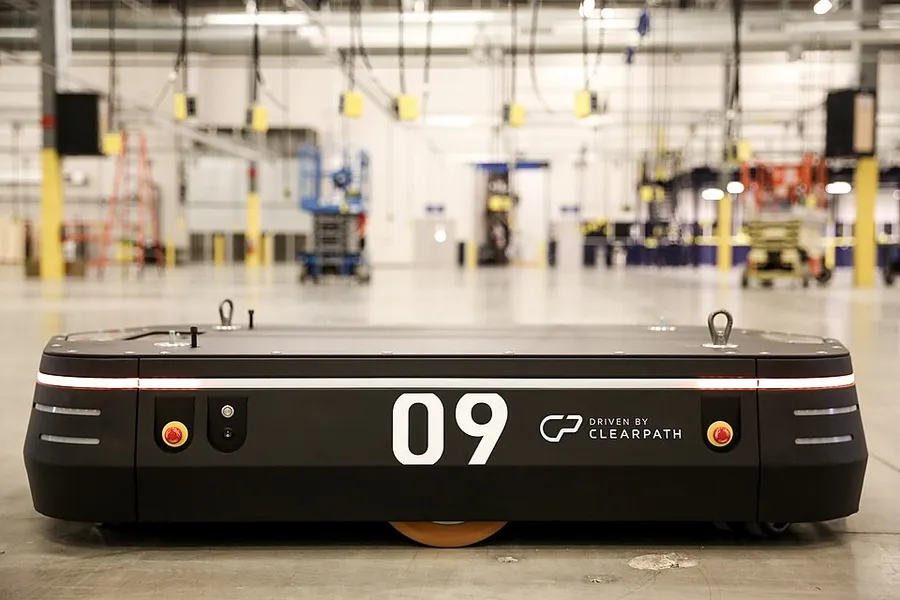
The cheapest option on the market, suited to milk-run work delivering raw materials between stations on a fixed schedule. It follows a fixed route guided by magnetic tape or QR codes — this is the type most widely used by automotive factories in Thailand.
2. AGV Forklift (from ฿2.5M)
Lifts pallets onto racking just like a manned forklift. It suits warehouses looking to cut accidents where forklifts hit people or racking — a core pain point for Thai warehouses. You can weigh the value against a manned forklift in AGV vs. Forklift.
3. AMR (from ฿1.5M)
More expensive than an AGV, but it needs no floor tape, no line shutdown during installation, and layout changes are free — it uses SLAM to map the space itself. It suits e-commerce/3PL warehouses whose layout changes every quarter. If you still can’t decide between the two, read the full AGV vs. AMR guide.
4. G2P Solution (projects of ฿15M+)
Goods-to-person systems like Geekplus/Quicktron — the kind Lazada/Shopee use — are a whole-system purchase (20+ vehicles + racking + software), priced as a project rather than per unit.
Hidden Costs That Blow Out the Budget (More Important Than the Vehicle Price)
The figure in the quotation is not the true cost. Three areas catch Thai factories out most often:
- Integration with WMS/MES — ฿300,000-2,000,000 depending on your existing system. If your WMS is a legacy system with no API, budget extra — and this is the part that most often delays the project.
- Site preparation — Wi-Fi must cover the entire travel route (AMRs need stable handoff between access points), and the floor must be level with no changes in grade — this typically runs ฿100,000-500,000.
- Maintenance + batteries — 5-8% of the vehicle price per year, with batteries replaced every 3-5 years (฿50,000-200,000 per unit).
ROI Example: An Automotive Parts Factory
The scenario: moving parts between production lines across 2 shifts, using 4 material handlers per shift (8 total × ฿18,000 = ฿144,000/month):
- Investing in 2 tugger AGVs + integration ≈ ฿2,800,000
- Cutting material handlers to 2 per shift → saving ฿72,000/month
- Payback in ~39 months — and once you include the hard-to-measure benefits (fewer goods damaged in transit, no staffing shortages), the real payback point is usually shorter.
Try running your own factory’s numbers in the ROI Calculator.
Checklist Before Requesting a Quote
- Know your real payload + travel distance per trip + number of trips per day
- Will the layout change within 2 years? (Changes often → AMR; stays fixed → AGV is cheaper)
- Does your current WMS/MES have an API? Ask the vendor point-blank what integration costs, itemized separately
- Ask for a reference site in Thailand that has been running for more than a year
Not sure which type of AGV suits your factory, or how many units to start with? Get free advice — we compare every brand impartially.
Related FAQ
What is the starting price for a factory AGV?
For 2026 in Thailand, a small tugger/tray-carrying AGV (500 kg payload) starts at ฿800,000-1,200,000 per unit, a mid-size unit (1,500 kg) runs ฿1.2-2.0M, and an AGV forklift is ฿2.5-4.5M — all before integration costs.
How much do AGVs and AMRs differ in price?
At the same payload, an AMR costs roughly 50-100% more than an AGV (a 100-300 kg AMR starts at ฿1.5-2.5M) because it uses LiDAR + SLAM navigation. In return, it needs no floor tape or floor prep, and you can change the layout with no reinstallation cost.
What are the hidden costs of an AGV system?
Budgets usually blow out in three places: (1) integration with your WMS/MES at ฿300,000-2,000,000, (2) site preparation such as full Wi-Fi coverage, a level floor, and ramps at ฿100,000-500,000, and (3) maintenance + batteries at roughly 5-8% of the vehicle price per year.
How many years until an AGV investment pays back?
In a typical Thai case, one AGV replaces 2-3 material handlers per shift; running two shifts, that saves ฿70,000-130,000/month. A ฿1.5-2.5M system therefore pays back in about 1.5-2.5 years.